Routine checks that keep CNC routers, edge banders, drilling machines and beam saws accurate and running: what to do every shift, every week, and when to call service.
Short answer: daily maintenance of woodworking machines means removing chips and dust, checking compressed air and lubrication, inspecting tools and safety devices, and cleaning the parts that touch the panel. Weekly maintenance adds a deeper clean of guides and rails, lubrication according to the schedule, a check of belts, filters and wear parts, and a backup of programs. A short logbook turns these checks into early warnings before a fault stops production.
Key takeaways
- Most unplanned stops start with dirt, low air pressure, missing lubrication or worn tools, all of which are visible in a daily check.
- Remove dust with extraction or a vacuum where possible; blowing compressed air into guides and bearings pushes dirt deeper.
- Follow the lubrication points, intervals and lubricants given in the machine documentation.
- Record every check and every abnormal noise, temperature or error message in a logbook.
- Always switch off and secure the machine before cleaning or maintenance.
Why routine maintenance matters
Unplanned downtime is the most expensive hour in a workshop. Periodic maintenance keeps a machine out of that hour: wear parts are replaced before they fail, geometry is checked before it drifts, and the software is kept up to date. The checklist below is a general starting point. The exact intervals depend on the machine group, your shift pattern and the material you run, and AXTEA sets them together with you when the machine is commissioned.
Safety first: before any cleaning or maintenance, stop the machine, switch off the main switch, secure it against restart, release compressed air where required, and let hot units such as glue pots cool down.
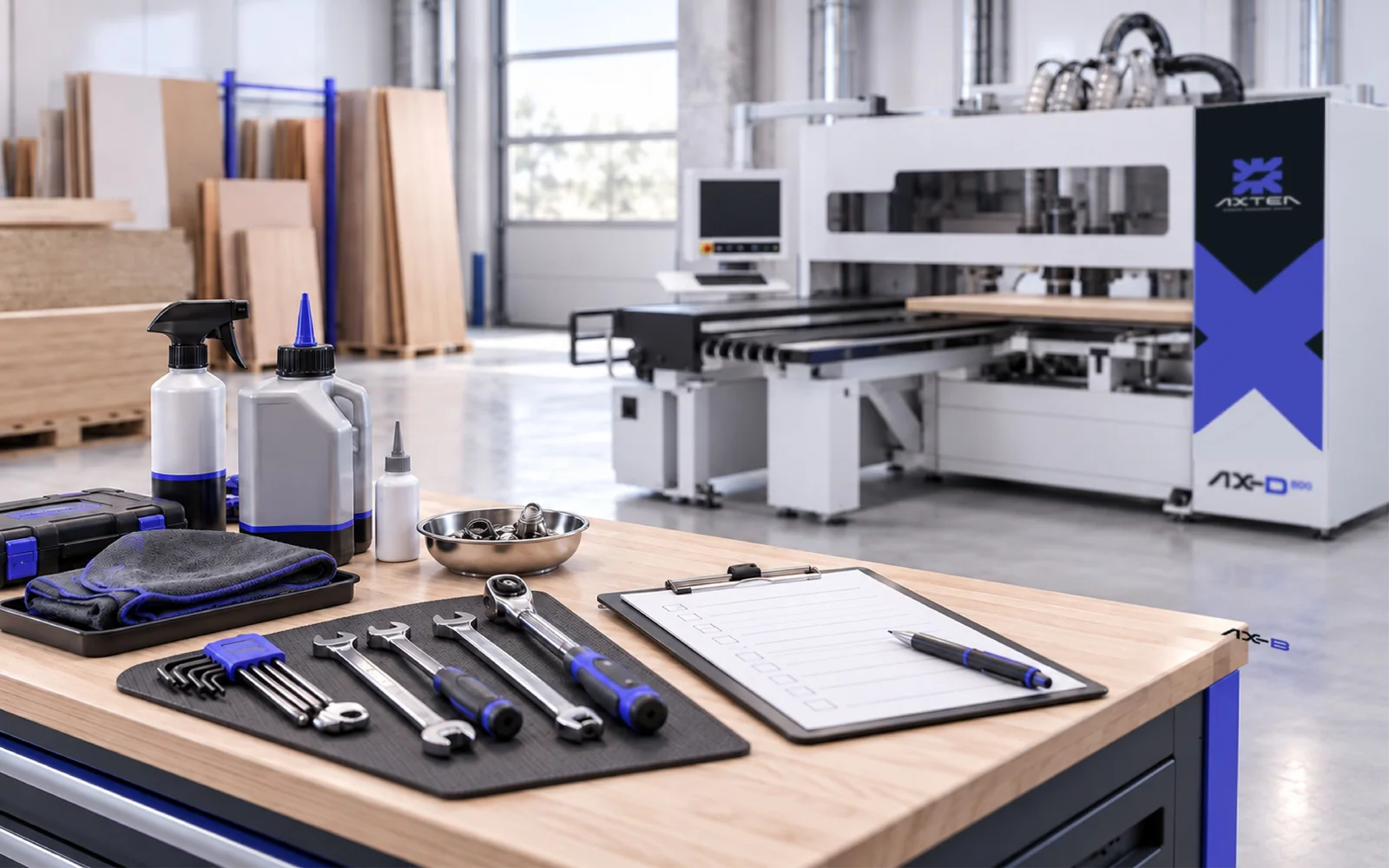
Daily checklist for all machines
| Check | What to look for |
|---|---|
| Chips and dust | Remove chips from the working area, tables, guides and sensors, preferably with a vacuum. |
| Compressed air | Correct pressure on the gauge; drain water from the separator or filter. |
| Dust extraction | Extraction running and gates open before start-up; no blocked hoses. |
| Lubrication | Oil and grease levels in automatic lubrication units where fitted. |
| Tools | Sharpness, chipping and correct clamping of cutters, drills and blades. |
| Safety devices | Emergency stops, guards, light curtains and interlocks working. |
| Control panel | No new alarms or warnings at start-up. |
Weekly checklist for all machines
- Clean linear guides, rails and racks, and check their wipers and covers.
- Lubricate the points listed for weekly intervals in the documentation.
- Check belts, chains and couplings for wear and tension.
- Clean or replace air and vacuum filters as needed.
- Check cables, hoses and energy chains for damage or rubbing.
- Back up machine programs, tool tables and parameters.
- Review the logbook and plan replacement of wear parts that are close to their limit.
CNC routers and nesting machines
- Daily: clean the vacuum table and check the spoilboard for flatness and leaks; clean the tool holders and the spindle taper before tools are loaded; check the tool magazine for chips.
- Weekly: check the vacuum pump filter and oil level where applicable; check vacuum zone seals; inspect the drilling unit spindles; resurface the spoilboard when hold-down drops.
Read about the AX-N 200 CNC router.
Edge banding machines
- Daily: clean the glue pot and glue roller after work according to the documentation; check that glue temperature is reached before running; clean pressure rollers, scrapers and the buffing unit; check that anti-adhesive and cleaning agent tanks are filled.
- Weekly: inspect the pre-milling cutters, trimming and corner rounding tools; check the edge band feeding system and the guillotine; clean the conveyor chain pads and the top pressure beam.
The AX-E 300 page explains the main units of an edge banding line, from pre-milling to buffing.
CNC drilling machines
- Daily: clean the panel support and the grippers; remove chips from the drilling heads; check drills for breakage.
- Weekly: check the drilling head spindles and clamping; clean barcode readers or cameras where fitted; check the panel reference stops.
Beam saws
- Daily: inspect the main saw and scoring saw blades; clean the saw carriage area and the air flotation tables; check the grippers and the pressure beam.
- Weekly: check the alignment of the scoring saw to the main saw; clean the carriage guides; check the rear lifting table and loading system where fitted.
When to call service
Call service when you notice a new noise or vibration, a temperature rise in spindles or motors, a loss of accuracy, repeated alarms, or air or oil leaks. AXTEA usually connects to the machine remotely first through its call center, which often resolves the fault outright and otherwise tells the technician which parts and tools to bring. Planned periodic maintenance and on-site repair are part of our repair and maintenance service.
Keep a maintenance logbook
Record the date, the checks done, parts replaced, alarms and anything unusual. A logbook shows trends, such as a spindle that runs warmer every week, and gives the service engineer the history needed to find the cause quickly.
Frequently asked questions
How often should a CNC router be maintained?
Daily cleaning and checks every shift, weekly lubrication and inspection of wear parts, and periodic service at intervals set by the manufacturer according to the machine, your shift pattern and material.
Can I clean a woodworking machine with compressed air?
Use a vacuum or extraction where possible. Blowing compressed air into guides, bearings and electrical parts can push dust and chips deeper into them.
How do I keep an edge banding machine running well?
Clean the glue system and pressure rollers daily, keep anti-adhesive and cleaning agent tanks filled, and check trimming, scraping and corner rounding tools every week.
Do you maintain machines that are out of warranty or from other brands?
Yes. Repair, maintenance and spare part support continue for the whole life of the machine, independently of warranty status, and AXTEA supports machines across a wide range of brands and models.