A step-by-step checklist for the weeks before a woodworking machine arrives: layout, floor, power, compressed air, dust extraction, network access, delivery route and the people who will run it.
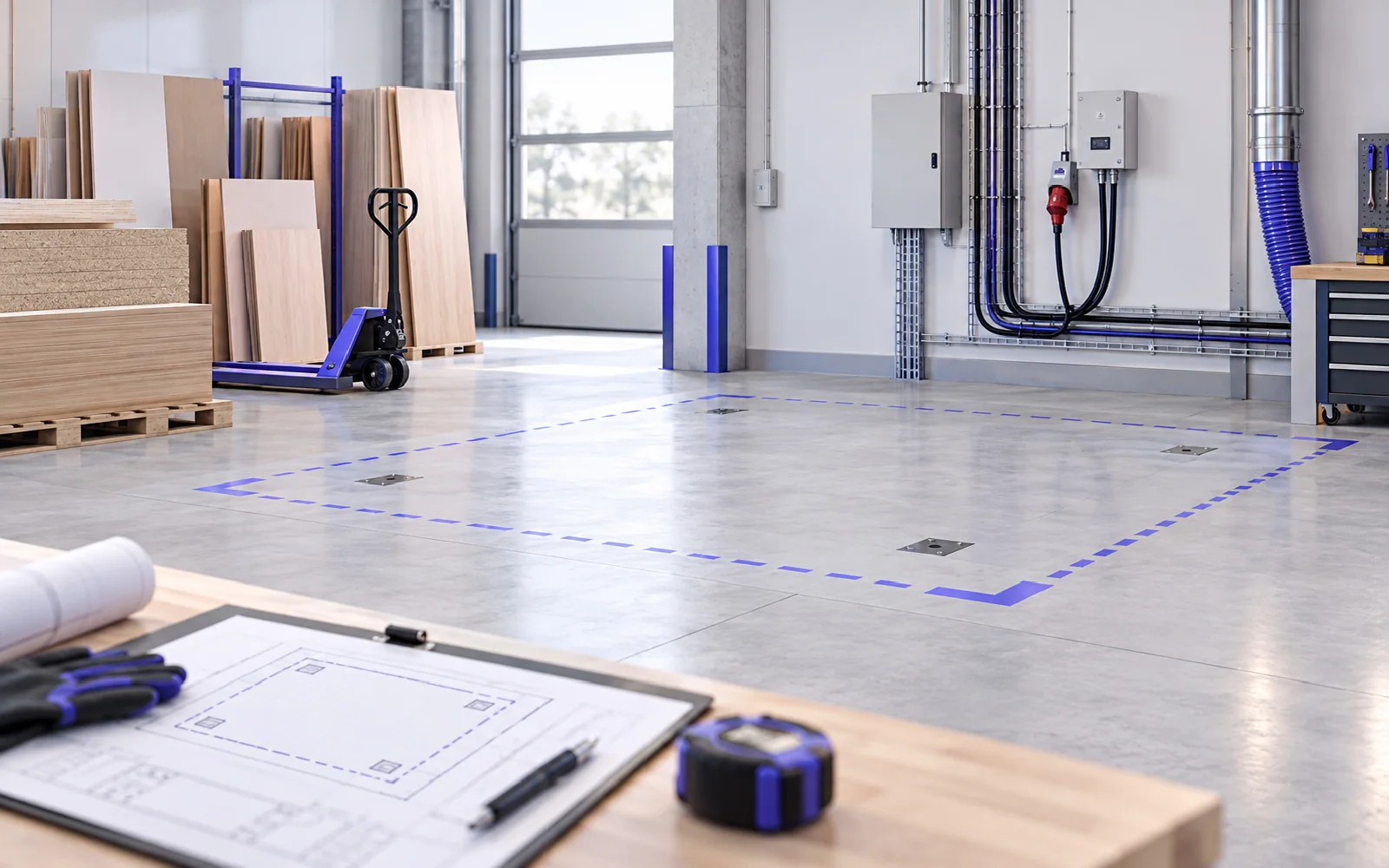
Short answer: a workshop is ready for a new woodworking machine when the layout is agreed, the floor is level and strong enough, three-phase power, compressed air and dust extraction are available at the machine position, an internet connection is ready for remote support, the delivery route is clear, and the operators who will be trained are scheduled. Preparing these in advance turns installation day into assembly instead of improvisation.
Key takeaways
- Agree the machine position and material flow with your supplier before the infrastructure work starts.
- Always confirm voltage, frequency, power rating, air pressure and extraction airflow from the machine’s documentation.
- Dust extraction and electrical work usually have the longest lead times; start them first.
- Measure the delivery route, including doors, turns and floor load, before the truck arrives.
- Schedule the operators who will be trained for the full commissioning period.
Why preparation matters
Most delays on installation day have nothing to do with the machine. They come from a missing power outlet, an extraction duct of the wrong size, a door that is too narrow or a floor that is not level. AXTEA plans the machine layout within your production area and identifies the infrastructure it will need before delivery, as part of its installation, training and commissioning service. The checklist below shows what that planning covers.
1. Layout and material flow
Place the machine where material naturally flows: raw sheets in, finished parts out toward the next operation. For a nesting CNC router, plan space for loading full sheets on one side and unloading parts on the other. For an edge banding machine, plan the infeed and outfeed lengths plus the return path for panels. For a beam saw, plan the loading area or lifting table at the rear and the stacking area at the front.
- Leave maintenance access around the machine, especially at electrical cabinets, the vacuum pump and lubrication points.
- Keep walkways clear and separate from the loading area.
- Consider future machines: leave room to add the next step of your line.
2. Floor
The machine needs a flat, level, load-bearing concrete floor without cracks or expansion joints under its feet. Unevenness is corrected with levelling feet only within a limited range, so a poor floor affects accuracy. Ask your supplier for the machine weight and foundation requirements, and check whether the machine must be anchored.
3. Electrical supply
Industrial woodworking machines run on a three-phase supply. Confirm the exact voltage, frequency and total power from the machine documentation: common supplies are 380/400 V at 50 Hz in Europe and Türkiye, 208/230/480 V at 60 Hz in the United States and 220 V at 60 Hz in Mexico.
- Install a dedicated, correctly rated circuit breaker for the machine.
- Provide a proper protective earth connection.
- Bring the cable to the planned position of the machine’s electrical cabinet, with enough length for final connection.
- Plan separate supplies for the vacuum pump and dust extraction if they are not powered from the machine.
Electrical work must be done by a qualified electrician according to local regulations.
4. Compressed air
Pneumatic clamps, tool changers, pressure rollers and cleaning units need clean, dry compressed air. Typical working pressure for woodworking machines is around 6–8 bar, but the required pressure and consumption must be taken from the machine documentation.
- Size the compressor for the total consumption of all machines on the line.
- Use an air dryer and filters; water and oil in the air damage valves and cylinders.
- Provide a shut-off valve and a connection point near the machine.
5. Dust extraction
Effective chip and dust extraction protects operators, keeps cut quality high and reduces fire risk. Each machine has defined extraction outlets with a required airflow. The extraction system, ducting diameters and fan must be sized for the total airflow of the machines that run at the same time, with enough air velocity to carry chips without settling in the ducts.
- Get the number, diameter and airflow of the machine’s extraction outlets from the documentation.
- Route ducts as short and straight as possible, with blast gates for machines not in use.
- Follow local fire and explosion protection rules for wood dust.
6. Network for remote support
Many faults can be diagnosed without a site visit if the supplier can connect to the machine control. All that is required is an internet connection at the machine. Plan a network cable or a reliable connection point near the control panel, and agree with your IT team how remote sessions are opened. Read more about the AXTEA call center and remote connection.
7. Environment
- Keep the workshop within the operating temperature and humidity range given in the documentation; extreme cold affects glue in edge banding and lubrication.
- Protect electronics from direct water, heavy dust and direct sunlight.
- Provide good lighting at the control panel and loading areas.
8. Delivery and unloading
Measure the full route from the truck to the final position: gates, doors, corridors, turning points and floor load. Check the machine’s transport dimensions and weight with your supplier and arrange suitable lifting equipment, such as a forklift or crane with enough capacity and fork length. Keep the area clear on delivery day.
9. People and software
Training covers day-to-day operation, tool and program changes, routine maintenance and safety procedures. Make sure the operators who will run the machine, and the person responsible for programming, are available for the whole commissioning period. If you use CAD/CAM software, have it installed and licensed so the post-processor can be set up and tested on your own parts.
Preparation timeline
| When | What to do |
|---|---|
| At order | Agree layout and material flow; request infrastructure requirements from the supplier. |
| Early | Start electrical, compressed air and dust extraction work; these usually take longest. |
| Before delivery | Check the floor, measure the delivery route, arrange lifting equipment and network access. |
| Delivery week | Clear the area, confirm operator availability and have CAD/CAM software ready. |
| Commissioning | Test cuts and acceptance runs on your own material, then operator training. |
Frequently asked questions
What do I need before a CNC router is installed?
A level concrete floor, a three-phase power supply with a dedicated breaker, clean and dry compressed air, a dust extraction system sized for the machine, an internet connection for remote support, a clear delivery route and trained operators scheduled for commissioning.
How much compressed air pressure does a woodworking machine need?
Typical working pressure is around 6–8 bar, but always use the pressure and air consumption stated in the machine documentation, and make sure the air is dried and filtered.
Who plans the machine layout?
AXTEA plans the machine layout within your production area together with your team and identifies the infrastructure requirements before the machine arrives.
What happens on commissioning day?
The machine is positioned, levelled and connected, then calibrated and tested with cuts and acceptance runs on your own material until it produces to specification. Hands-on operator training follows on the machine itself.
Can you help with an existing workshop layout?
Yes. Contact us with a floor plan and a list of your current machines, and we will help plan the position and material flow for the new machine.